FinitHicDeo: A CTF Built Around Protocol Behaviour
An introduction to FinitHicDeo, its programming and request-smuggling themes, and the evidence I would keep while solving the lab.
Contents
Challenge overview
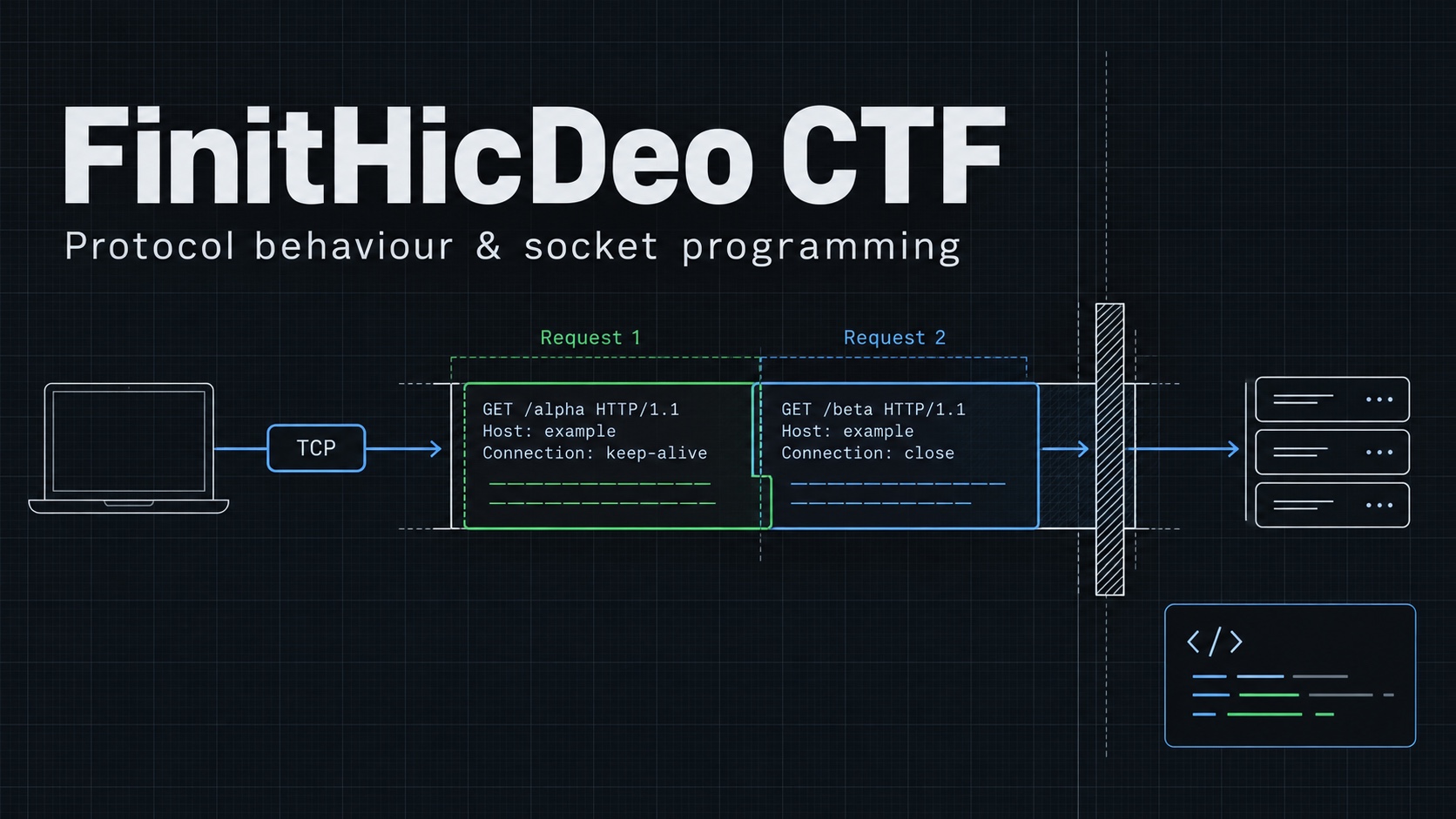
FinitHicDeo is a downloadable CTF machine I created with Nachiket Rathod. I wanted a lab that encouraged research into protocol behavior, including HTTP request smuggling, alongside a programming task.
The VulnHub entry describes the VM and provides the download. The GitHub repository contains the original introduction and a Google Drive download link.
My original post introduced the challenge rather than documenting a complete solve. I keep that distinction here. The notes below explain the themes and how I approach the lab; they do not claim an unrecorded foothold or flag.
Authorized testing only
Only run this against systems you own or have written permission to test.
Set up the machine
I import the VM into a compatible hypervisor and place it on an isolated lab network with my testing machine. The published machine uses DHCP, so I find its assigned address rather than relying on an address from someone else's walkthrough.
I take a snapshot before beginning. That gives me a known starting point if an experiment changes application state or breaks a service.
Recon
I start by identifying the services exposed by the imported machine. In the following command, LAB_VM_IP must be replaced with the address assigned inside my isolated lab:
nmap -sV -oN finithicdeo-services.txt LAB_VM_IP
The default scan is an initial inventory, not proof that every port has been checked. I follow up based on what the machine exposes and what the challenge requires.
For a web service, I save a normal request and response before testing parser behavior. For a custom TCP service, I record the greeting, prompts, delimiters, and connection behavior. Those details tell me what a script needs to send and receive.
Foothold
The original notes mention a Bulls and Cows-style guessing task handled through a Python socket connection. A useful client needs more than a loop that sends guesses. It needs to understand the service's actual message format.
I first establish whether the secret uses digits or words, whether symbols can repeat, and how the response distinguishes a correct position from a correct symbol in the wrong position. I do not assume those rules from the game's name.
For a solver, I would keep a candidate set and remove entries that disagree with each response. Before automating guesses, I would verify the scoring logic against a few manually understood cases.
A TCP read can return part of a message or several messages together. I therefore buffer received bytes until the protocol's delimiter or length condition is met. Assuming one recv() equals one response is an easy way to build a solver that works intermittently.
Escalation or solve
The other theme in the original post is HTTP request smuggling involving Gunicorn. The important question is how components decide where a request ends.
A reproducible demonstration needs the actual deployment: server versions, any intermediary, the exact bytes sent, and evidence that components disagree about request boundaries. Naming Gunicorn alone does not identify an affected version or prove a vulnerability.
I keep the programming task and request-smuggling task separate until the evidence establishes how they connect. The original post did not document their order, so I do not invent a chain between them.
For a completed solve, I would preserve each transition: the observation, the successful action, and the new access or information it provided. That makes the reasoning easier to follow than a collection of final commands.
Flag
The original notes did not include a flag, its location, or a final verification step.
Dead ends and lessons
I do not have a recorded list of failed attempts from the original run. The useful habits I would carry into a fresh attempt are straightforward: capture the protocol before writing the solver, test one framing hypothesis at a time, and keep the VM's versions with the evidence.
The point of this machine is to make me explain why an input changes a service's behavior. That explanation is the part worth keeping after the challenge is finished.
Ask or Share Thoughts
Your message goes straight to me. Email is optional. The form records your IP address and browser information.