Deep Learning for Threat Detection: Reading the Evidence Before the Accuracy Claim
How I read a survey of deep learning for threat detection, distinguish research claims from deployment evidence, and evaluate practical tradeoffs.
Contents
Why I read this survey
Security systems produce more data than an analyst can inspect manually. I am interested in machine learning when it helps narrow that workload, identify useful patterns, or surface evidence that would otherwise be missed.
That interest brought me to A Survey on Deep Learning Models for Cyber Threat Detection Systems, an EasyChair preprint by Tolulope Olufemi and Wilson Sakpere dated March 8, 2023.
My earlier post summarized the paper too confidently. A survey can help map a field, but it does not establish that one model will improve detection in my environment. I want to separate what the source discusses from the evidence I would need to deploy something.
What the source covers
The preprint discusses deep learning for cyber threat detection, including wireless sensor networks and MQTT-based data transport. Its wider literature review touches on network intrusion detection, botnet and IoT forensics, object recognition, and mobile forensics.
The full preprint is the source for those discussions. It includes work involving network datasets and related forensic applications. I treat those as distinct tasks with different evidence requirements, rather than combining them into a single claim of high accuracy.
I also keep the publication type clear: this is a preprint. My notes do not establish its peer-review status or independently reproduce its referenced experiments.
Define the detection task first
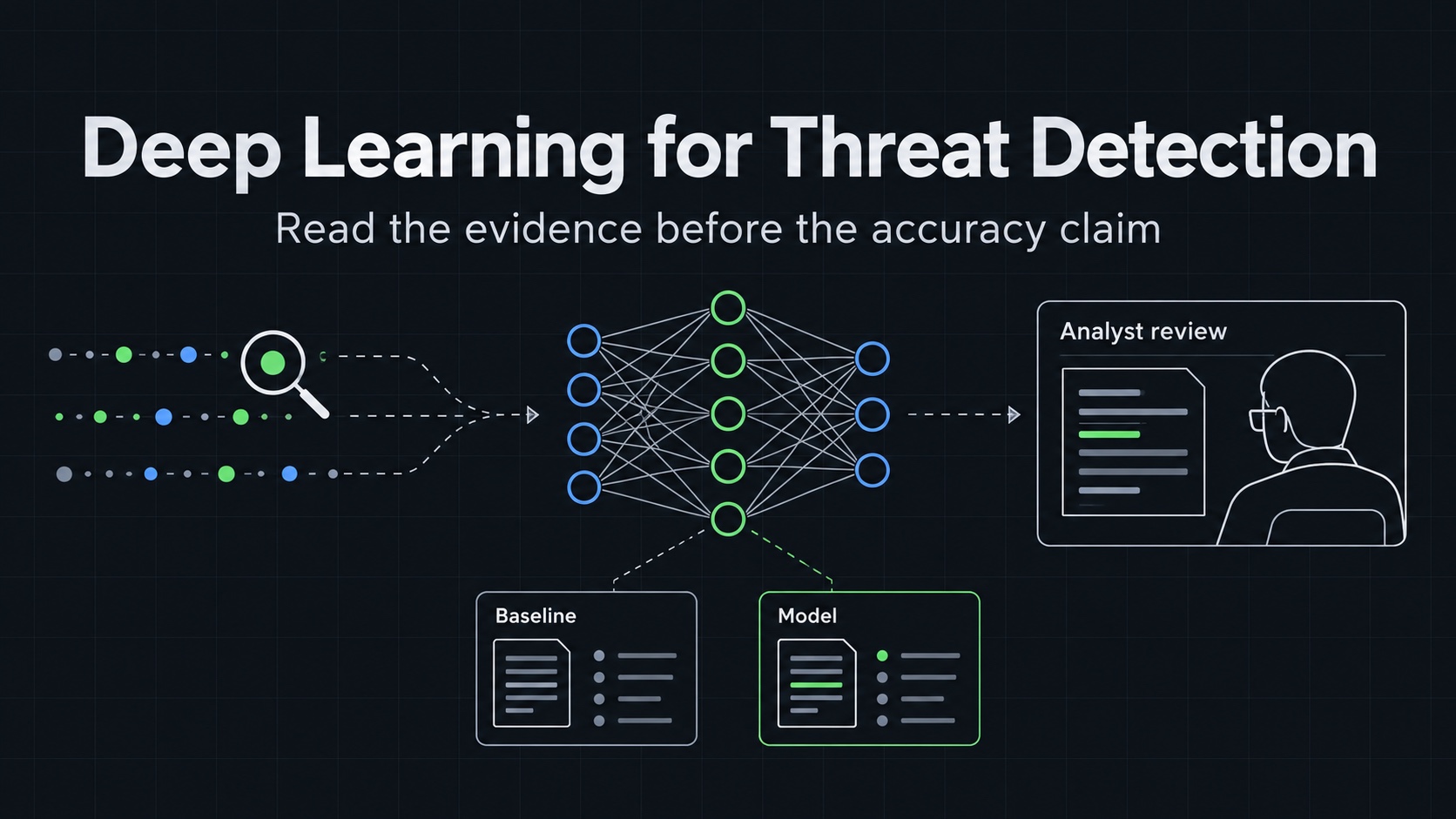
Before comparing model families, I want one clear description of the task. What is being classified, where does the data come from, and what action follows a positive result?
Network-flow classification, image object recognition, and mobile forensic triage are different problems. A model that performs well on one does not inherit that performance on another just because both are security applications.
I also distinguish detection from prevention. A model can identify a suspicious event after it happened. Preventing that event requires a response path with the right timing and authority.
For a candidate system, I would write down the input features, the label being predicted, the expected decision time, and the person or process that will receive the result.
Read the dataset before the score
The first thing I ask about an accuracy claim is how the data was divided. If training and test sets contain closely related traffic or repeated artifacts from the same collection, the evaluation may be easier than the deployment problem.
I want to know whether a model learned behavior associated with an attack or incidental details of the dataset. Collection periods, host identities, and the way labels were created can all affect that judgment.
For a practical review, I use questions like these:
| Question | Why I ask it |
|---|---|
| Where were the labels obtained? | Incorrect or ambiguous labels change the meaning of the score. |
| How were training and test examples separated? | Closely related examples can make generalization look stronger than it is. |
| Which attack classes are represented? | A dataset cannot demonstrate coverage of attacks it does not contain. |
| What benign behavior is included? | Ordinary variation determines how often analysts see false alerts. |
| Does the evaluation include later or external data? | A fixed test split says little about change over time. |
These are my evaluation criteria. I am not claiming that the preprint answers every one of them or that I have rerun the experiments.
Use metrics that match the workflow
Overall accuracy is easy to quote and easy to misread. In a dataset dominated by benign activity, a high score can hide poor detection of the events I care about.
I look at precision, recall, false-positive behavior, and results for each relevant class. Then I translate those into an analyst's workload. A detector that finds useful events but floods the queue can still fail operationally.
I also want the threshold and its tradeoff. Changing a threshold may catch more malicious activity while increasing false alerts. The useful choice depends on what the response team can investigate and what a missed event would cost.
I do not add performance percentages to this article because the original notes did not contain a reproducible result table with the model, split, and evaluation procedure.
Compare with a simpler baseline
I do not assume that deep learning is the right starting point for every detection problem. I would compare it with a simpler model and with the rules or existing detector the team already uses.
That comparison needs more than a score. I would include inference cost, training time, feature collection, failure handling, and how easily an analyst can inspect a result.
For a constrained sensor deployment, I would also check where the model runs. A design evaluated on a workstation may have different memory, power, and latency limits from a sensor node. MQTT transport describes how data moves; it does not, on its own, establish detection quality.
Keep forensic claims separate
The original post included named claims about cyberbullying, steganography, object recognition, intrusion detection, and mobile forensics. Some attributions did not match the cited survey, so I avoid repeating them as verified findings.
For forensic use, I want a clear record of the original evidence and the model's role in selecting or classifying it. An automated label can prioritize an item for review, but it does not replace explaining what the evidence shows.
A useful research note names the original study when making a specific result claim. A useful deployment note adds the local validation. I keep those levels of evidence separate.
What would persuade me to try it
I would start with a bounded task, a representative dataset, an inspectable baseline, and an evaluation that reflects the future workflow. I would keep the model version and preprocessing steps with the results.
Then I would review failure cases with the people expected to act on alerts. That conversation can reveal problems a headline metric hides: repeated false alerts, missing context, or an output that arrives too late to help.
The question I keep from the survey is practical: does this model produce better decisions from the data and resources I actually have? The answer needs an experiment, not a stronger adjective.
Ask or Share Thoughts
Your message goes straight to me. Email is optional. The form records your IP address and browser information.