reconFTW: Building a Repeatable Reconnaissance Workflow
How I set up reconFTW, choose a bounded workflow, and turn collected reconnaissance data into findings I can verify.
Contents
Why I use reconFTW
Reconnaissance gets repetitive. I collect candidate hostnames, resolve DNS, check reachable services, and review what changed. reconFTW helps coordinate that work so I can spend more time on the results.
The project is maintained by six2dez and integrates a collection of reconnaissance and security tools. I think of it as a workflow around those tools. Its output still needs scope checks and manual review.
My original post listed many integrations by name. Those dependencies have changed over time, so I now organize the workflow by what I need to learn rather than by a fixed tool inventory. The project repository is the source for the current integration list.
Authorized testing only
Only run this against systems you own or have written permission to test.
Install and setup
I use a dedicated assessment environment with enough disk space and a clear record of installed dependencies. The installer can change the toolchain and paths, so I review it before running it.
For the Bash workflow described here:
git clone https://github.com/six2dez/reconftw
cd reconftw
git rev-parse HEAD
less install.sh
./install.sh
./reconftw.sh -h
The project also documents other deployment methods. I match the instructions to the checkout I am using. A different entry point or release can have different configuration and output conventions.
Before the first scan, I check which configuration file that checkout loads. I review enabled modules, concurrency, resolvers, output locations, and any external API credentials. I keep secrets out of shared scan archives.
An API-backed module can return little data because a key is absent, expired, or rate limited. That is different from a completed search that found nothing.
Choose a workflow before choosing a target
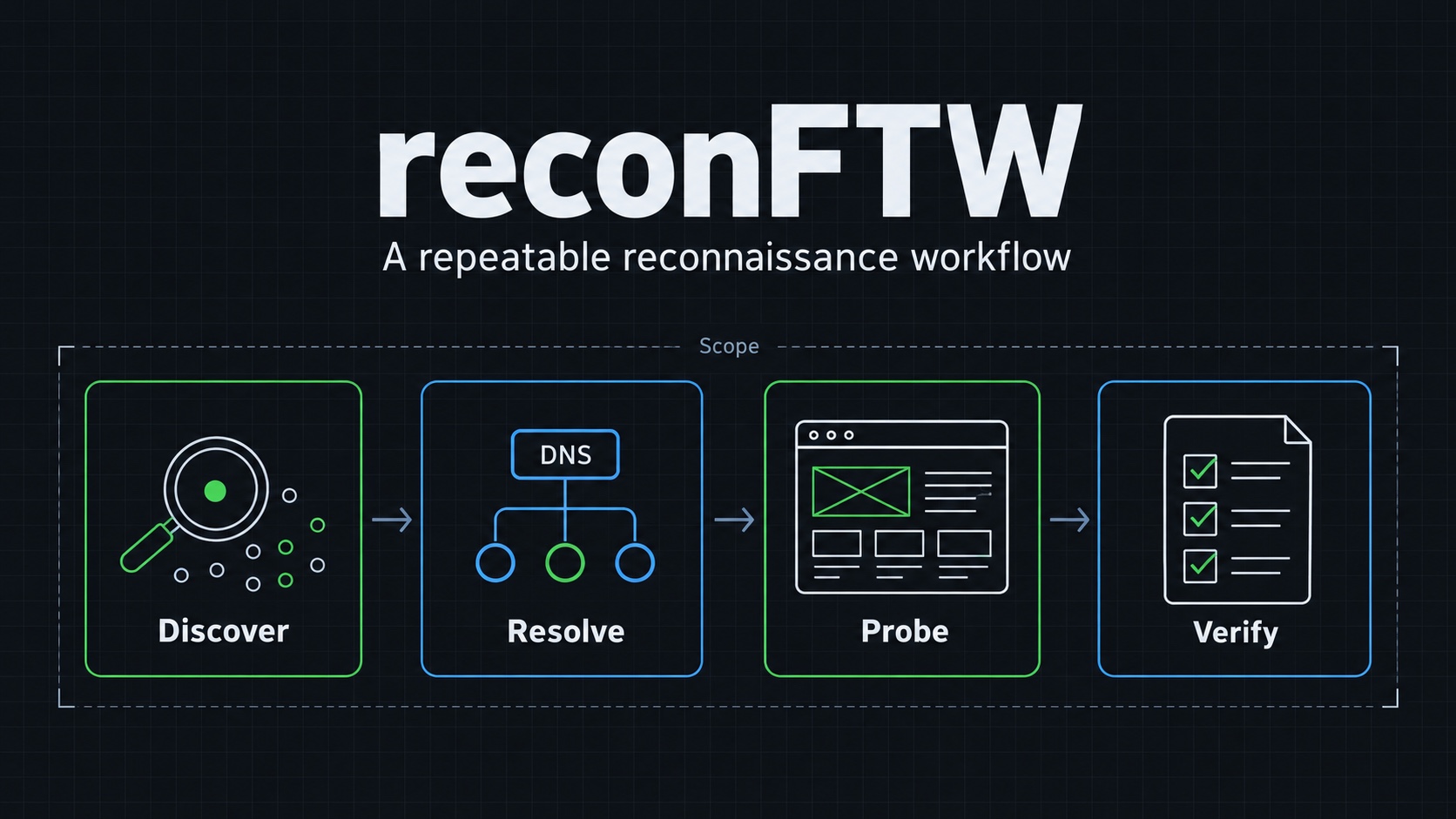
I divide the work into a few questions:
| Stage | What I want to learn | What I validate |
|---|---|---|
| Passive discovery | Which names and URLs have been observed? | Source, timestamp, and ownership. |
| DNS resolution | Which candidate names resolve now? | Wildcards and shared infrastructure. |
| Service discovery | Which approved services respond? | Actual host, port, and protocol. |
| Web analysis | Which applications and endpoints are present? | Redirects, authentication, and duplicate hosts. |
| Vulnerability checks | Which behaviors deserve investigation? | A repeatable request and a meaningful response. |
This keeps the final report from becoming a list of scanner messages. It also helps me notice when a stage did not run successfully.
Basic usage
The documented Bash entry point accepts a domain with -d. A passive workflow is a useful place to begin:
./reconftw.sh -d example.com -p
For an approved active reconnaissance run:
./reconftw.sh -d example.com -r -o ./assessment-output
Both commands use a placeholder domain. I replace it with the agreed target and confirm the behavior of the selected mode in local help before running it. Passive collection still involves external services and their data-handling rules.
For several approved domains, I use a file with one domain per line:
./reconftw.sh -l domains.txt -r -o ./assessment-output
These examples follow the project's usage instructions. I do not assume a discovered domain or a redirect destination is automatically in scope.
A run I can review
I begin with one approved domain and keep its outputs separate. After the run, I inspect what was actually created:
find ./assessment-output -type f | sort
I compare those files with the enabled modules and the execution log. If I expected DNS resolution but see only passive candidates, I investigate that gap before using the list for active testing.
For a useful example in a report, I keep the chain small: a hostname from a named source, a current DNS answer, a reachable service, and one manually verified observation. I include dates because reconnaissance data ages quickly.
Tips and gotchas
Wildcard DNS can make invented hostnames look valid. A shared IP can host unrelated customers. An archived URL can point to infrastructure the organization no longer controls. I check those cases before broadening a target list.
Resume support is useful after an interrupted run, but a resumed job is not necessarily a fresh baseline. I record the original start time and identify stages that reused earlier results.
I also resist enabling every optional module at once. Missing dependencies and noisy output are easier to diagnose in a small workflow.
Detection and defence
For a coordinated assessment, I share the approved source addresses and test window with defenders. I compare DNS, web, and network logs against the stages I ran.
The useful output is a short set of verified assets and observations, with enough provenance to repeat the work. The framework helps me gather evidence; deciding what that evidence means remains my job.
Ask or Share Thoughts
Your message goes straight to me. Email is optional. The form records your IP address and browser information.