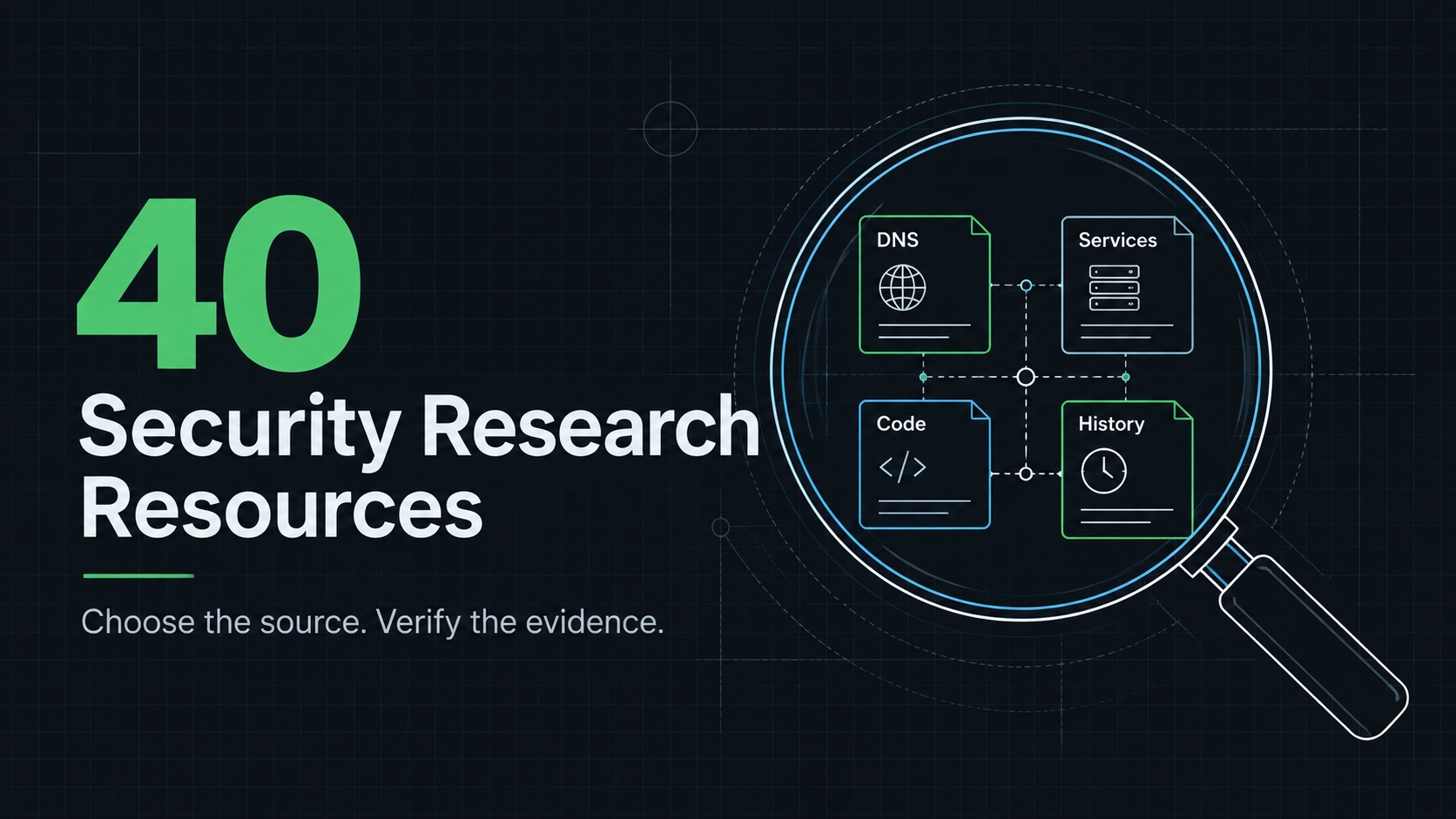
40 Security Research Resources, Grouped by the Question They Answer
A practical directory for infrastructure research, threat intelligence, code search, and historical context, with corrections to older entries.
Contents
- Choose the question before the search engine
- Discover infrastructure and DNS relationships
- Add threat and indicator context
- Search source code, web history, and published vulnerabilities
- Investigate public exposure and identity leads
- Historical entries and links that need another check
- Keep the evidence behind the lead
Choose the question before the search engine
I keep a directory of research resources because different indexes show different parts of the same problem. One can help me find exposed services. Another can explain a DNS history, a suspicious IP, or a code fragment.
My original list called all 40 entries search engines. That was too loose. It included scanning services, commercial intelligence platforms, archives, and historical resources whose current role needs checking.
I have kept the original 40 entries, grouped them by purpose, and corrected descriptions that could lead me to draw the wrong conclusion. The review date is October 27, 2026. A link that could not be verified is marked as such; a failed page fetch is not proof that the entire service has shut down.
I have removed old claims about exact index sizes and free access. Those change too often to help with the decision at hand.
Discover infrastructure and DNS relationships
I use these resources to build candidate asset lists and investigate relationships. An indexed hostname or IP is a lead. I still check current ownership, observation time, and assessment scope.
| Original entry | Resource | What I use it to investigate |
|---|---|---|
| 2 | SecurityTrails | DNS and domain relationships, including historical records. Its API examples document historical lookup use. |
| 5 | ZoomEye | Internet-asset discovery. This is the current site identified during the review; the old article used the .org domain. |
| 9 | FOFA | Indexed internet assets and service characteristics. I confirm query syntax in the current interface. |
| 10 | LeakIX | Indexed service and exposure observations. An exposure label still needs context and validation. |
| 11 | DNSDumpster | DNS reconnaissance and candidate hosts related to a domain. |
| 12 | FullHunt | Internet intelligence and asset-discovery data. I separate indexed candidates from confirmed organizational assets. |
| 14 | ONYPHE | Internet exposure and threat-intelligence data. The original .io site redirects here. |
| 19 | Shodan | Internet-facing services and their observed properties. A banner is not a verified vulnerability. |
| 20 | Netlas | Service, DNS, certificate, and related internet-asset research. |
| 21 | crt.sh | Certificate Transparency searches that can reveal certificate-associated names. Issuance does not prove a service is currently reachable. |
| 27 | Censys | Internet intelligence and exposure research. The original .io address redirects to this site. |
For this group, I save the collection date as well as my search date. A historical record can explain an old relationship without describing the present deployment.
I also avoid treating a shared IP, certificate, or nameserver as conclusive ownership evidence. Shared services can connect unrelated customers.
Add threat and indicator context
These resources help me interpret an indicator. They do not replace local telemetry or establish what an IP or domain was doing at the time of my incident.
| Original entry | Resource | What it adds |
|---|---|---|
| 6 | Pulsedive | Threat-intelligence search and indicator context. |
| 8 | PolySwarm | Threat-detection and sample-analysis context. The application requires its current supported interface. |
| 13 | Open Threat Exchange | The intelligence-sharing service relevant to the original AlienVault entry. The old corporate homepage was an imprecise link. |
| 16 | urlscan.io | Existing website-scan results and controlled URL analysis. Searching an existing result differs from submitting a new scan. |
| 17 | Vulners | Vulnerability intelligence and links between advisories, exploits, and affected assets. |
| 25 | GreyNoise | Context about internet scanning and network threat activity. My old description incorrectly treated it as a general device-search service. |
| 35 | AbuseIPDB | Reports of abusive IP activity. I examine dates and report context before acting on a score. |
When results disagree, I keep the disagreement visible. The providers may observe different activity, use different time windows, or attach different meanings to a label.
Before submitting a URL or file to an analysis service, I check its visibility and sharing settings. A private URL, token, or internal sample can become an unintended disclosure if the submission is public.
Search source code, web history, and published vulnerabilities
This group helps me understand implementation details and recover context. I distinguish an archived artifact from a current deployment and an exploit reference from proof that my target is affected.
| Original entry | Resource | What I look for |
|---|---|---|
| 4 | Exploit Database | Published exploit references and related technical details. I review prerequisites before using any code. |
| 15 | grep.app | Code and symbol searches across its indexed repositories. I check the repository and revision behind a hit. |
| 18 | Wayback Machine | Archived pages and historical site context. Archive coverage can be incomplete. |
| 23 | PublicWWW | Snippets and markers in indexed HTML, JavaScript, and CSS. Useful for following shared frontend identifiers. |
| 29 | Packet Storm | Security news, advisories, and technical material. The old packetstormsecurity.com address redirects here. |
| 30 | searchcode | Repository code search and code-intelligence tooling. Its current service differs from the enormous global index described in my old post. |
For a code-search result, I follow the hit to the source and record the revision. A copied snippet can be outdated or unreachable in the actual application. For an exploit reference, I verify the affected product, version, configuration, and original advisory.
Investigate public exposure and identity leads
These resources were also in the original directory. I use the resulting data only for a defined investigation, and I keep inferred identity relationships separate from confirmed facts.
| Original entry | Resource | Appropriate question |
|---|---|---|
| 1 | DeHashed | Has an approved identity or organizational identifier appeared in indexed breach data? A result is not permission to use recovered credentials. |
| 7 | GrayHatWarfare | Has public cloud-storage content been indexed that may belong to the organization? I confirm ownership and intended exposure. |
| 26 | Hunter | Which business email addresses or patterns are associated with an organization? An address alone does not establish a person's current role. |
| 28 | Intelligence X | What indexed material may provide context for a domain or identifier? Coverage and access depend on the current service. |
I prefer a narrow question over downloading a broad dataset. That makes the result easier to justify, easier to validate, and easier to handle responsibly.
Historical entries and links that need another check
The remaining original entries need extra care. Some have changed purpose, some did not return enough information during this review, and some were described inaccurately in the old article. I retain them for continuity, without presenting them all as current recommendations.
| Original entry | Resource | Correction or verification needed |
|---|---|---|
| 3 | DorkSearch | Originally listed as a Google-dorking aid. Current functionality could not be verified in this review. |
| 22 | WiGLE | Originally included for wireless-network observations. The site blocked this review's automated fetch; verify current access and coverage directly. |
| 24 | BinaryEdge | Historical internet-scanning entry. The old homepage returned an error during review; confirm its current service before using this link in a workflow. |
| 31 | Spyse | Historical asset-discovery entry. I could not verify current availability or functionality. |
| 32 | Netograph | The page identifies the service as detailing the web, but provided no readable feature description. My original network-traffic-analysis description is unverified. |
| 33 | Vigilante | Historical Intel 471 link. The original community-platform description could not be verified. |
| 34 | Pipl | Identity-related historical entry. Verify the present product, account requirements, and permitted use; do not assume a public people-search interface. |
| 36 | Maltiverse | Originally listed for threat-intelligence searches. Current application access could not be verified. |
| 37 | Insecam | Historical webcam-aggregation entry. I do not use exposed camera feeds as an asset-ownership check or treat public reachability as permission to view private activity. |
| 38 | Anubis | Historical malware-analysis entry. I could not verify a currently usable submission service. |
| 39 | Phonebook.com | The current landing page describes general people and business search, including sponsored results. The old reverse-phone-lookup description is not established. |
| 40 | InQuest | Now redirects to an OPSWAT MetaDefender NDR product page. It should not be presented as the same public research search service. |
Keep the evidence behind the lead
For each useful result, I save the query, source, relevant observation time, and a short explanation of what it establishes. Then I look for an independent source or direct confirmation within the assessment scope.
Authorized testing only
Only run this against systems you own or have written permission to test.
That authorization check matters when moving from searching an index to testing a discovered service. A search result does not expand an engagement's scope.
The directory is useful when it gets me to the next answer quickly. I stop adding sources when they repeat the same unverified assertion, and spend that time checking the observation that actually matters.
Ask or Share Thoughts
Your message goes straight to me. Email is optional. The form records your IP address and browser information.